-
-
W-199-E, MIDC Khairne, Thane Belapur Road, Navi Mumbai – 400705. India.
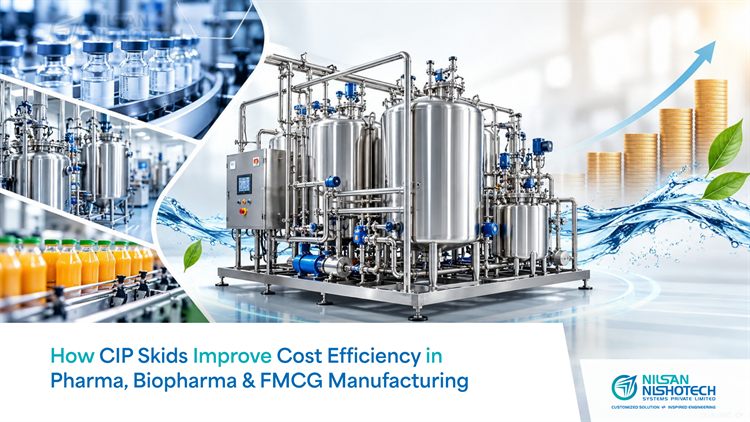
How CIP Skids Improve Cost Efficiency in Pharma, Biopharma & FMCG Manufacturing
21 Oct 2026
How CIP Skids Improve Cost Efficiency in Pharma, Biopharma & FMCG Manufacturing
A CIP skid (Clean-in-Place system) helps manufacturers clean compatible process equipment without routine dismantling. By automating cleaning cycles, controlling water and chemical consumption, and improving cleaning consistency, a well-designed CIP system can help reduce operating costs in pharmaceutical, biopharma, and FMCG manufacturing.
For Plant Heads and Project Managers, the goal is to achieve reliable cleaning while optimizing labour, utilities, and production time without compromising quality.
What Is a CIP Skid and How Does It Work?
A CIP skid is an integrated cleaning system that circulates cleaning solutions through tanks, reactors, pipelines, and other compatible equipment. Depending on the application, it includes pumps, tanks, valves, dosing units, sensors, heating arrangements, and automated controls.
These components manage cleaning parameters such as temperature, flow rate, chemical concentration, and cycle duration. In regulated pharmaceutical manufacturing, cleaning procedures must be documented and appropriately validated to demonstrate consistent cleaning effectiveness.
Ways CIP Skids Improve Cost Efficiency
1. Reduces Manual Cleaning Labour
Automated CIP systems reduce the need for routine dismantling and manual cleaning of compatible equipment. This helps optimize operator time, reduce equipment handling, and support smoother production changeovers.
2. Optimizes Water and Chemical Consumption
Controlled dosing and predefined cleaning recipes help manage water and cleaning-agent usage. Actual savings depend on the existing cleaning process, equipment design, and cleaning requirements.
3. Supports Energy Efficiency
Optimized heating, circulation, and cycle settings can help manage energy consumption. Cleaning parameters must remain within approved operating requirements to maintain effective results.
4. Helps Reduce Cleaning-Related Downtime
Repeatable cleaning cycles make production scheduling and product changeovers more predictable. The time saved depends on equipment configuration, cleaning requirements, and post-cleaning inspection procedures.
5. Improves Cleaning Consistency and Traceability
Automated controls execute predefined cleaning sequences and can record relevant cycle data. This supports process monitoring, troubleshooting, and documentation, while appropriate validation and quality approval remain essential.
CIP Systems for Pharma, Biopharma and FMCG Applications
Different manufacturing industries require application-specific cleaning solutions.
Pharmaceutical manufacturing: CIP systems support cleaning strategies designed to manage product residues and cross-contamination risks while meeting applicable quality and validation requirements.
Biopharma manufacturing: Cleaning requirements depend on biological materials, process equipment, contamination risks, and facility-specific procedures.
FMCG manufacturing: CIP integration can support frequent product changeovers and automated cleaning of compatible tanks, pipelines, and processing equipment.
Nilsan Nishotech provides CIP solutions for pharmaceutical and cosmetics processing lines and highlights CIP integration for FMCG applications.
Which Parameters Should a CIP Skid Control?
Effective cleaning depends on maintaining suitable operating conditions throughout the cleaning circuit. Key parameters may include:
- Temperature: Supports the required cleaning action.
- Flow rate: Helps achieve appropriate solution circulation.
- Chemical concentration: Maintains the specified cleaning-agent strength.
- Contact time: Defines the duration of cleaning-solution exposure.
- Cycle sequence and rinsing: Supports the correct cleaning stages and removal of cleaning-agent residues.
These parameters must follow the approved cleaning procedure. Reducing cycle time, temperature, or chemical concentration without adequate evidence can compromise cleaning effectiveness.
Manual Cleaning vs Automated CIP Skids
Manual cleaning may require less initial equipment investment, but it can involve greater operator intervention and variable execution. Automated CIP skids require upfront investment, installation, maintenance, and appropriate qualification, but can improve repeatability and process control.
Before investing, compare labour, utilities, chemicals, downtime, maintenance, and lifecycle costs. Establish baseline consumption and evaluate the new system against equivalent cleaning outcomes that meet established acceptance criteria.
How Nilsan Nishotech Supports CIP Requirements
Nilsan Nishotech offers custom-built CIP systems for pharmaceutical and cosmetics processing lines, with features including automated, recipe-based cleaning cycles. Its FMCG solutions also highlight CIP integration with controlled temperature, chemical dosing, and flow rates.
System selection should consider equipment compatibility, cleaning requirements, automation, utilities, documentation, and future production needs.
Conclusion
A well-engineered CIP skid can help manufacturers manage cleaning costs, optimize resource consumption, reduce routine manual intervention, and improve cleaning consistency. The best results come from application-specific design, suitable automation, and verified cleaning performance.
Planning a CIP system for your facility? Contact Nilsan Nishotech at info@nilsan-nishotech.com to discuss your process and cleaning requirements.
Frequently Asked Questions
1. How does a CIP skid reduce operating costs?
It can help optimize labour, water, chemicals, energy, and cleaning-related downtime through controlled, repeatable cleaning cycles.
2. Is a CIP skid suitable for pharmaceutical manufacturing?
Yes. The system must suit the equipment, product residues, contamination risks, and applicable cleaning-validation requirements.
3. Can CIP skids be used in biopharma and FMCG plants?
Yes. They can support suitable applications when designed around process requirements, equipment compatibility, and cleaning procedures.
4. Which parameters are monitored in a CIP system?
Common parameters include temperature, flow rate, chemical concentration, contact time, and cleaning-cycle sequence.
5. Does automation eliminate cleaning validation?
No. Automation supports consistency and record keeping but does not replace required cleaning validation or quality approval.