-
-
W-199-E, MIDC Khairne, Thane Belapur Road, Navi Mumbai – 400705. India.
How Does a Pharmaceutical Mixing Vessel Maintain Product Uniformity?
26 Oct 2026
How Does a Pharmaceutical Mixing Vessel Maintain Product Uniformity?
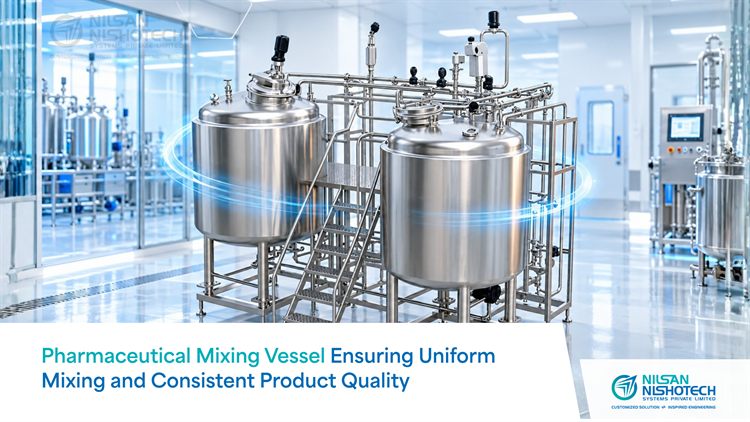
A Pharmaceutical Mixing Vessel helps combine ingredients into a consistent batch by creating controlled movement throughout the product. Uniformity depends on the agitator, vessel geometry, fill level, mixing speed, processing time, and material properties. These variables must be selected and checked for the specific formulation, not guessed from vessel size alone.
Key Takeaways: Mixing uniformity depends on the formulation, agitator, vessel design, speed, time, and fill level. Verify performance through suitable testing, then document and maintain proven operating conditions.
What Is Product Uniformity in Pharmaceutical Mixing?
Product uniformity means ingredients are distributed consistently through a batch so samples from relevant locations meet defined process or quality criteria. A suitable vessel supports this goal, but uniformity must be demonstrated through appropriate process checks and sampling.
In pharma and biopharma manufacturing, uneven mixing can create concentration differences, inconsistent texture, incomplete dissolution, or variable downstream processing. The risk depends on the product, whether it is a solution, suspension, buffer, or other formulation. Published pharmaceutical mixing research shows that mixing speed, vessel scale, fill volume, and mixing duration can affect process performance.
How Does a Pharmaceutical Mixing Vessel Maintain Uniformity?
A Pharmaceutical Mixing Vessel maintains uniformity when its mechanical design and operating conditions match the product's mixing needs. The key is to create sufficient circulation without causing unwanted foaming, excessive shear, or product damage.
1. Select the Right Agitator
The agitator creates circulation inside the vessel. Its type, diameter, position, and speed influence how material moves from the top, bottom, and sides of the tank. Low-viscosity liquids, viscous products, and suspensions may need different mixing arrangements.
2. Control Mixing Speed and Time
Higher speed does not always mean better mixing. The required speed and mixing duration depend on viscosity, batch volume, vessel geometry, and product sensitivity. Excessive mixing can introduce air, increase heat, or damage shear-sensitive materials; insufficient mixing can leave concentration differences.
3. Maintain the Correct Fill Level
The working volume affects circulation patterns and the area reached by the agitator. A vessel should be designed and operated within its intended fill range, with minimum and maximum batch sizes considered during equipment selection.
4. Monitor Critical Process Conditions
Temperature, pressure, batch weight, and mixing speed may need monitoring depending on the process. Sensors and load cells can help operators follow defined parameters and record batch information. Monitoring supports control, but it does not by itself prove that the entire batch is uniform.
How Can Teams Check Mixing Uniformity?
Teams should define product-specific acceptance criteria and use an appropriate sampling or testing plan. Depending on the formulation, checks may assess concentration, pH, viscosity, appearance, or another relevant quality attribute. The method should be scientifically suitable for the product and process.
What Should Be Documented?
Record the approved mixing speed, mixing time, batch volume, temperature range, sampling results, and any deviations. For a new formulation or larger vessel, evaluate whether the established conditions still achieve the required results.
Why Does Scale-Up Need Attention?
A process that mixes well in a small vessel may behave differently at production scale. Vessel dimensions, impeller geometry, fill level, and power input change the flow pattern, so scale-up should be evaluated rather than assuming the same rpm will work.
Which Vessel Features Support Consistent Mixing?
For pharmaceutical applications, consider product-contact material, surface finish, vessel geometry, agitator configuration, suitable instrumentation, and cleaning access. Nilsan Nishotech's process mixing vessel can be configured with SS 316L product-contact surfaces, a specified surface finish of ≤0.38 Ra, agitators, load cells, pressure and temperature sensors, and CIP/SIP integration where required. Confirm the specification against the particular project and product requirements.
FDA equipment guidance says equipment should be suitable for its intended use, cleaning, and maintenance, and product-contact surfaces should not adversely alter drug quality.
Pharmaceutical Mixing Vessel Selection Checklist for Plant Heads
Before approving a Pharmaceutical Mixing Vessel, Plant Heads and Project Managers should ask:
- Is the agitator suited to the product's viscosity and mixing objective?
- Has the working volume range been defined?
- Are temperature and pressure requirements clear?
- Can operators monitor and repeat the approved process?
- Can the vessel be cleaned effectively between batches?
- Have scale-up and future capacity requirements been considered?
A common mistake is selecting equipment mainly by capacity or motor power. Product behavior, required blend quality, cleanability, and the ability to reproduce the process are just as important.
Conclusion
A Pharmaceutical Mixing Vessel maintains product uniformity through suitable agitation, controlled speed and time, the correct working volume, appropriate monitoring, and evidence that the process meets its defined criteria. For pharma and biopharma manufacturers, equipment selection should consider formulation behavior, scale-up, cleaning, and documentation together.
For example, during buffer preparation in a biopharma process, uneven mixing can leave pH or concentration differences between sampling points. A Pharmaceutical Mixing Vessel should therefore be selected and tested around the actual formulation, not treated as a standard tank for every liquid.
Nilsan Nishotech offers configurable process mixing vessel solutions for defined manufacturing needs. To discuss your application, contact info@nilsan-nishotech.com.
Frequently Asked Questions
1. What Is a Pharmaceutical Mixing Vessel?
A Pharmaceutical Mixing Vessel is a processing vessel used to combine ingredients or prepare solutions under controlled conditions. It typically uses an agitator and may include process sensors and defined operating controls. The correct design depends on formulation properties, batch volume, hygienic requirements, and the required mixing outcome.
2. How Does a Pharmaceutical Mixing Vessel Maintain Uniformity?
Uniformity depends on matching the agitator, mixing speed, time, and working volume to the formulation. Teams verify performance using product-appropriate sampling and testing. Simply running the agitator or increasing its speed does not prove that material is uniformly mixed throughout the vessel.
3. Does Faster Mixing Always Produce Better Results?
No. Increasing mixing speed may improve circulation in some applications, but it can also introduce air, increase heat, or affect shear-sensitive products. The appropriate operating speed depends on formulation viscosity, vessel geometry, impeller design, and the required mixing result. Process testing helps establish suitable conditions.
4. Why Is SS 316L Used for Pharmaceutical Mixing Vessels?
SS 316L is commonly considered for pharmaceutical product-contact surfaces because material compatibility, corrosion resistance, and cleanability are important in hygienic manufacturing. The selected material and surface finish should suit the product, cleaning agents, operating conditions, and applicable equipment specifications.
5. What Is the Role of Load Cells in a Mixing Vessel?
Load cells measure the weight of the vessel and its contents, supporting controlled ingredient addition and batch monitoring. When correctly selected, installed, and calibrated, they can help operators verify batch quantities and improve process repeatability. They do not directly measure mixing uniformity.
6. Does CIP/SIP Guarantee Product Uniformity?
No. CIP, or Clean-in-Place, supports equipment cleaning, while SIP, or Sterilize-in-Place, supports in-place sterilization where required. Neither independently proves that ingredients have been uniformly mixed. Uniformity requires suitable process design, controlled operating conditions, and appropriate testing.