-
-
W-199-E, MIDC Khairne, Thane Belapur Road, Navi Mumbai – 400705. India.
What Is Water for Injection (WFI)? A Complete Guide for Pharmaceutical Manufacturers
23 Jul 2026
What Is Water for Injection (WFI)? A Complete Guide for Pharmaceutical Manufacturers
Can a pharmaceutical product be truly safe if the water used during manufacturing isn't of the highest purity? The answer is simple: no. That's why Water for Injection (WFI) plays a critical role in pharmaceutical manufacturing. Used in the production of injectable medicines, vaccines, biologics, and sterile products, WFI must meet the highest quality standards to ensure patient safety and regulatory compliance. From its generation and storage to distribution and validation, every stage of a WFI system is carefully designed to maintain exceptional purity. In this guide, we'll explore what Water for Injection is, why it matters, and how choosing the right WFI system can improve manufacturing performance.
What Is Water for Injection (WFI)?
Water for Injection (WFI) is the highest grade of pharmaceutical water used for manufacturing sterile medicines and injectable products. It is specially purified to remove microorganisms, endotoxins, dissolved salts, and organic contaminants, ensuring it meets the stringent standards defined by global pharmacopeias.
Because WFI comes into direct contact with pharmaceutical products, maintaining its quality is essential for product safety and patient health.
Where Is Water for Injection Used?
Have you ever wondered where WFI is used inside a pharmaceutical plant? Its applications extend across several critical manufacturing processes, including:
Injectable Drug Manufacturing
WFI is used to prepare sterile injections, vaccines, and intravenous solutions.
Equipment Cleaning
It is used for the final rinse of pharmaceutical equipment to prevent contamination.
Biopharmaceutical Production
Biotech facilities rely on WFI for sensitive manufacturing processes where purity is non-negotiable.
Laboratory Applications
Quality control laboratories use WFI for analytical testing and sample preparation.
How Is Water for Injection Produced?
Producing pharmaceutical-grade water requires advanced purification technologies and strict process control.
Typical WFI Generation Process
- Pre-treatment
- Reverse Osmosis (RO)
- Electrodeionization (EDI)
- Ultrafiltration (UF)
- Distillation or approved membrane-based technologies
- Storage and continuous distribution
Every stage is monitored to ensure consistent compliance with pharmaceutical standards.
Why Is Water for Injection So Important?
What happens if water quality is compromised during pharmaceutical manufacturing? Even minor contamination can impact product quality, patient safety, and regulatory compliance.
Benefits of a High-Quality WFI System
- Ensures sterile manufacturing
- Reduces contamination risks
- Supports GMP compliance
- Maintains consistent product quality
- Improves operational reliability
- Simplifies regulatory inspections
A properly designed WFI system protects both products and business reputation.
What Should You Consider Before Choosing a WFI System?
Selecting a Water for Injection system involves more than comparing technical specifications.
Key Factors
- Compliance with GMP, WHO, and USFDA guidelines
- Reliable automation and monitoring
- Hygienic storage and distribution design
- Validation and documentation support
- Scalability for future expansion
- Responsive after-sales service
The right partner will deliver both technology and long-term support.
Why Choose Nilsan Nishotech for Water for Injection (WFI)?
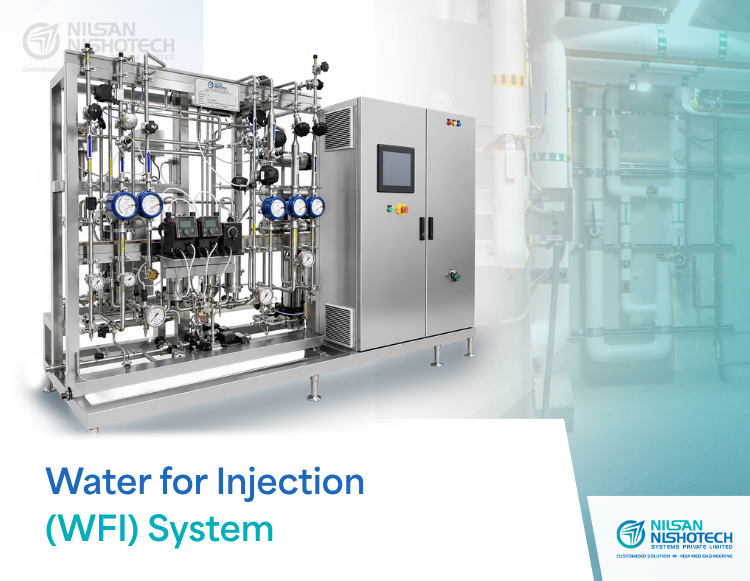
Nilsan Nishotech provides advanced Water for Injection (WFI) systems designed for pharmaceutical, biotechnology, and healthcare industries. Every solution is engineered to deliver reliable performance, hygienic operation, and compliance with global regulatory standards.
From system design and manufacturing to installation, validation, and lifecycle support, Nilsan Nishotech helps pharmaceutical manufacturers maintain the highest standards of water purity while improving efficiency and operational confidence.
Conclusion
As pharmaceutical manufacturing continues to advance, Water for Injection (WFI) remains one of the most critical components of sterile production. A dependable WFI system not only ensures compliance with international regulations but also protects product quality and patient safety. Investing in a well-designed, validated solution helps manufacturers operate more efficiently and confidently. With engineering expertise and customer-focused solutions, Nilsan Nishotech delivers WFI systems that support the evolving needs of modern pharmaceutical facilities.
Frequently Asked Questions
Why is Water for Injection (WFI) used instead of purified water?
Because WFI meets stricter purity standards required for sterile pharmaceutical products.
Can Water for Injection be used for all pharmaceutical manufacturing?
No, it is primarily used for sterile and injectable products where the highest purity is required.
How is WFI different from ordinary purified water?
WFI has much tighter limits for endotoxins and microbial contamination.
What industries commonly use WFI systems?
Pharmaceutical, biotechnology, vaccine, and healthcare manufacturing industries.
How is Water for Injection stored after production?
It is stored in hygienic tanks and circulated continuously through a validated distribution loop.
Does a WFI system require regular validation?
Yes, periodic validation ensures consistent performance and regulatory compliance.
What standards should a Water for Injection system comply with?
It should comply with GMP, WHO, USFDA, and applicable pharmacopeia requirements.
Why choose Nilsan Nishotech for Water for Injection (WFI)?
Nilsan Nishotech delivers customized WFI systems with advanced engineering, validation support, and reliable lifecycle services.