-
-
W-199-E, MIDC Khairne, Thane Belapur Road, Navi Mumbai – 400705. India.
How AI Is Transforming Pharmaceutical Water System Monitoring
24 Aug 2026
How AI Is Transforming Pharmaceutical Water System Monitoring
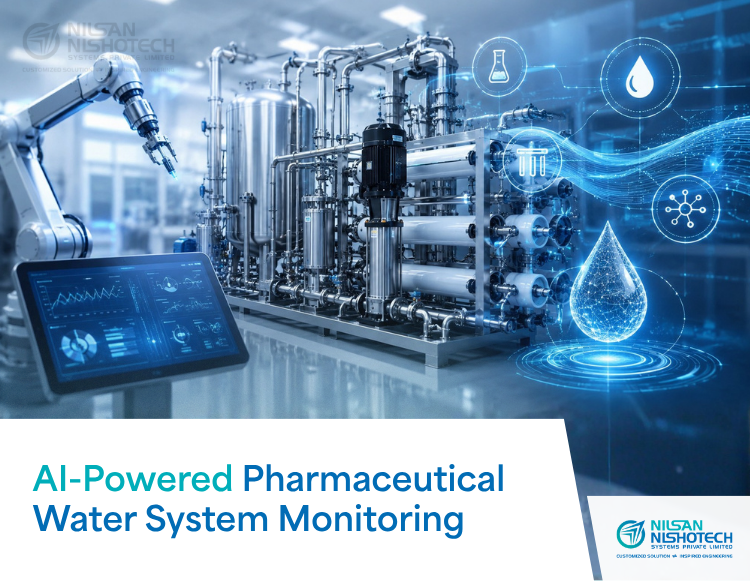
AI in Pharmaceutical Water Systems is changing how pharmaceutical manufacturers monitor, analyze, and manage critical water-system parameters. As high-purity water systems become more automated, artificial intelligence can help teams identify unusual patterns, improve predictive maintenance, analyze process data, and respond to potential issues faster.
For pharmaceutical facilities, AI is not about replacing established monitoring and control systems. Instead, it can work alongside sensors, automation, and data platforms to provide deeper insights into parameters such as conductivity, TOC, temperature, flow, pressure, and system alarms.
What Is AI in Pharmaceutical Water Systems?
AI in pharmaceutical water systems refers to using artificial intelligence and advanced data analytics to interpret information generated by water treatment, storage, and distribution systems.
A modern pharmaceutical water system can generate large amounts of operational data. AI-based tools can analyze this information over time and identify patterns that may not be immediately visible through conventional monitoring.
This can support better decision-making while maintaining human oversight and established quality procedures.
How AI Can Improve Pharmaceutical Water Quality Monitoring
Water quality monitoring is essential in pharmaceutical manufacturing. Parameters such as conductivity and Total Organic Carbon (TOC) can provide important information about water quality.
AI can analyze historical and real-time data to identify unusual changes or patterns.
For example, an AI-enabled analytical system could recognize that conductivity is gradually changing under specific operating conditions. Instead of simply generating an alarm after a predefined limit is exceeded, advanced analytics may help identify the developing trend earlier.
Key Parameters AI Can Analyze
AI-powered pharmaceutical water systems can potentially analyze data from:
- Conductivity sensors
- TOC monitoring systems
- Temperature sensors
- Flow meters
- Pressure transmitters
- Tank-level sensors
- System alarms
- Pump operating data
- Distribution-loop parameters
The value comes from connecting these data points and interpreting them together rather than viewing each parameter independently.
AI for Predictive Maintenance in Pharma Water Systems
Unexpected equipment failure can affect production schedules and increase maintenance costs. Predictive maintenance in pharmaceutical water systems uses operational data to identify conditions that may indicate developing equipment problems.
AI can compare current operating patterns with historical information to identify anomalies.
For instance, changes in pump performance, pressure, flow, or operating cycles may indicate that equipment requires investigation. Maintenance teams can then evaluate the situation before a significant failure occurs.
From Reactive to Predictive Maintenance
Traditional maintenance often depends on fixed schedules or responding after a problem occurs.
AI-supported predictive maintenance can help move toward a more data-driven approach:
Monitor → Analyze → Detect Pattern → Investigate → Maintain
This approach can help improve equipment reliability while reducing unnecessary maintenance activities.
AI and IoT in Pharmaceutical Water Systems
The combination of AI and IoT in pharmaceutical water systems can create a connected monitoring environment.
IoT-enabled sensors can collect operational information from different parts of the system, while AI can process that information to identify trends and potential anomalies.
Why Connected Data Matters
Consider a situation where temperature, flow, and pressure change simultaneously. Looking at each value separately may not provide enough information.
AI-based analytics can evaluate relationships between multiple parameters and highlight patterns that require attention.
Can AI Detect Anomalies?
Yes, AI-based analytics can be designed to identify unusual patterns in historical or real-time data.
However, an anomaly does not automatically mean that a water-quality failure has occurred. It should trigger appropriate investigation and review by qualified personnel.
Does AI Replace Human Monitoring?
No. AI should support engineers, operators, and quality teams rather than replace established controls, procedures, qualification, or human decision-making.
How Can AI Support Smarter Water Management?
AI can help transform large volumes of system data into useful insights, making it easier for teams to identify trends, investigate deviations, and plan maintenance activities.
Benefits of AI-Powered Pharmaceutical Water Systems
When appropriately designed and validated, AI-powered analytics can provide several potential benefits:
- Earlier anomaly detection
- Improved predictive maintenance
- Better use of historical system data
- Faster identification of operational trends
- Improved equipment monitoring
- More informed maintenance planning
- Greater visibility into water-system performance
The actual benefits depend on sensor quality, data integrity, system architecture, analytics capabilities, and appropriate validation.
How Nilsan Nishotech Can Support the Future of Smart Water Systems
Nilsan Nishotech develops high-purity water systems for pharmaceutical and other industries where controlled water quality is critical. Its solutions incorporate technologies such as RO, EDI, UV, UF, monitoring, automation, storage, and distribution.
As pharmaceutical manufacturing moves toward increasingly connected operations, intelligent data analysis can complement these technologies by helping teams understand system performance more effectively.
The future of pharmaceutical water management is likely to combine high-purity water technology, automation, sensors, data analytics, and AI to create smarter and more responsive systems.
Frequently Asked Questions
What is AI in pharmaceutical water systems?
AI in pharmaceutical water systems uses artificial intelligence and data analytics to analyze system information, identify patterns, and support monitoring and maintenance decisions.
Can AI monitor pharmaceutical water quality?
AI can analyze data from monitoring instruments such as conductivity and TOC systems. It can help identify trends and unusual patterns, while established quality controls remain essential.
How does AI support predictive maintenance?
AI can analyze equipment and process data to identify patterns associated with potential equipment issues, allowing maintenance teams to investigate problems earlier.
Can AI detect anomalies in water systems?
Yes. AI-based analytics can identify deviations or unusual patterns across parameters such as flow, pressure, temperature, conductivity, and other monitored variables.
Does AI replace pharmaceutical water system automation?
No. AI can complement automation by adding advanced analytics and predictive insights to existing monitoring and control infrastructure.
Conclusion
AI is opening new possibilities for pharmaceutical water system monitoring by turning operational data into actionable insights. From conductivity and TOC monitoring to temperature, flow, pressure, alarms, and equipment performance, AI can help identify patterns that support proactive decision-making.
However, successful implementation requires more than simply adding AI. Reliable sensors, high-quality data, appropriate automation, cybersecurity, validation, and qualified human oversight remain essential.
For pharmaceutical manufacturers looking to build reliable and future-ready high-purity water systems, combining proven water-treatment technologies with intelligent monitoring can create a stronger foundation for operational efficiency and long-term system performance.
To learn more about high-purity water systems and smart water-system solutions, contact Nilsan Nishotech at info@nilsan-nishotech.com.