-
-
W-199-E, MIDC Khairne, Thane Belapur Road, Navi Mumbai – 400705. India.
What Is an Ointment Manufacturing System and How Does It Work for Pharma and Biopharma?
24 Aug 2026
What Is an Ointment Manufacturing System and How Does It Work for Pharma and Biopharma?
An ointment manufacturing system is an integrated production setup designed to manufacture consistent, smooth, and controlled semi-solid pharmaceutical products. In the pharmaceutical and biopharma industries, the system must support controlled processing, reliable mixing, effective homogenization, hygienic operation, and reproducible batch quality.
The exact process depends on the formulation and intended use, but the overall objective is to manufacture ointments consistently while maintaining appropriate process and quality controls. GMP principles emphasize suitable equipment, defined processes, cleaning, documentation, and consistent product quality.
What Is an Ointment Manufacturing System?
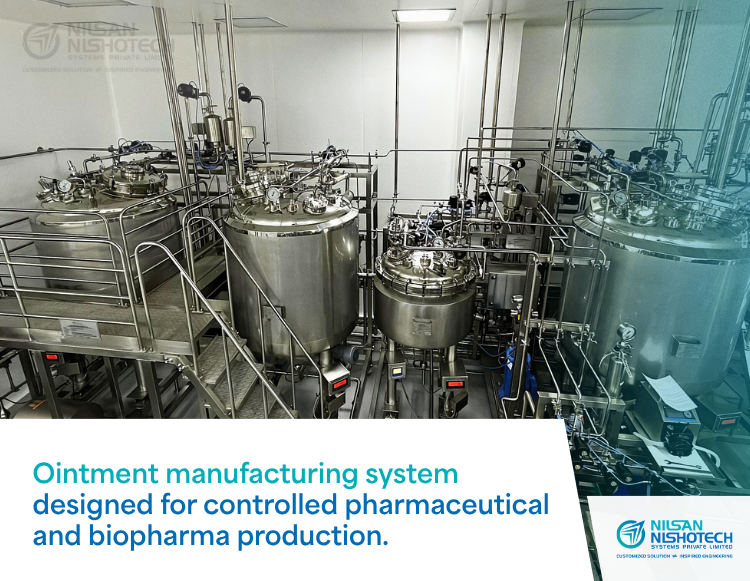
An ointment manufacturing system is a set of interconnected vessels, mixing equipment, processing controls, transfer arrangements, and supporting systems used to manufacture pharmaceutical ointments.
It is designed around the formulation and production requirements of the facility. Depending on the product, processing can involve ingredient preparation, heating, mixing, emulsification or homogenization, controlled cooling, and transfer to the next manufacturing stage.
For pharma and biopharma manufacturers, equipment design should also support effective cleaning and maintenance and minimize the risk of contamination or cross-contamination.
How Does an Ointment Manufacturing System Work?
The manufacturing process generally follows a controlled sequence.
1. Raw Material Preparation
The required ingredients are weighed and prepared according to the approved manufacturing process. Depending on the formulation, materials may require separate preparation before they are combined.
2. Phase Preparation and Heating
Formulations containing different material phases may require controlled preparation before mixing. Heating conditions are selected according to the formulation and process requirements.
3. Mixing and Homogenization
Prepared materials are combined in the main manufacturing vessel. Mixing helps distribute ingredients throughout the batch, while homogenization can help achieve the required texture and uniformity.
For emulsion-based products, controlled homogenization is particularly important because the process can influence particle or droplet distribution and final product characteristics.
4. Vacuum Processing
Where the formulation and equipment design require it, vacuum processing can help reduce entrapped air during manufacture. This can support a smoother product and more controlled processing. Vacuum-based ointment systems are commonly designed to combine controlled mixing, homogenization, and deaeration in a closed manufacturing environment.
5. Controlled Cooling
After the required processing conditions are achieved, the product may be cooled under controlled mixing. Cooling conditions can affect viscosity, texture, and product consistency, so the process should be controlled according to the validated formulation.
6. Transfer and Filling
Once the batch reaches its defined processing condition, it can be transferred through the designated product-transfer system for subsequent storage or filling.
What Are the Key Features of an Ointment Manufacturing System?
A suitable system may include:
- Manufacturing vessels
- Preparation vessels
- Agitation and mixing arrangements
- Homogenization capability
- Vacuum processing
- Heating and cooling control
- Product-transfer arrangements
- Process instrumentation
- Cleaning provisions
- Control and monitoring systems
The actual configuration should be selected according to the formulation, batch size, production capacity, cleaning requirements, and facility design.
Why Is Homogenization Important in Ointment Manufacturing?
Homogenization helps achieve uniform distribution within the product. It can influence texture, consistency, appearance, and other critical product characteristics.
For pharmaceutical manufacturing, the objective is not simply fast mixing. The process must be reproducible and appropriately controlled so that the finished batch meets its defined requirements.
Why Is Vacuum Used in Ointment Manufacturing?
Vacuum can help reduce entrapped air during processing. Depending on the formulation, this can support product appearance, consistency, and controlled processing.
How Does Temperature Affect Ointment Quality?
Temperature can influence material flow, viscosity, mixing behavior, and the physical properties of the final product. Therefore, heating and cooling conditions should be defined and controlled as part of the manufacturing process.
Why Is Equipment Hygiene Important?
Production equipment should be designed, installed, and maintained to support effective cleaning and reduce contamination risks. WHO GMP guidance emphasizes equipment suitability, effective cleaning, maintenance, and prevention of cross-contamination.
Can One System Manufacture Different Ointment Products?
A properly designed system may support multiple products, but compatibility, cleaning validation, changeover requirements, formulation characteristics, and production capacity must be evaluated before using one system across different products.
Ointment Manufacturing in Pharma and Biopharma
In the pharmaceutical and biopharma industries, an ointment manufacturing system must fit into a broader GMP-controlled production environment. Equipment selection should consider process consistency, cleaning, maintenance, documentation, operator safety, and integration with the manufacturing facility.
The system should also be supported by defined procedures and appropriate qualification and validation activities where required. GMP places importance on clearly defined, validated, reviewed, and documented manufacturing processes.
How to Select the Right Ointment Manufacturing System?
Plant Heads and Project Managers should evaluate more than vessel capacity. Important considerations include:
- Formulation characteristics
- Batch size and future capacity
- Mixing and homogenization requirements
- Heating and cooling requirements
- Vacuum requirements
- Cleaning and maintenance
- Material compatibility
- Automation and process monitoring
- Facility integration
- Qualification and documentation requirements
A system selected around actual process requirements can support better consistency, easier operation, and long-term production planning.
Frequently Asked Questions
What is an ointment manufacturing system?
It is an integrated production system used to prepare pharmaceutical ointments through controlled mixing, processing, homogenization, temperature management, and product transfer.
What is the role of homogenization?
Homogenization helps achieve more uniform distribution and can influence the texture and consistency of the finished ointment.
Why is vacuum used?
Vacuum processing can help reduce entrapped air and support controlled processing, depending on the formulation and equipment design.
Is GMP important for ointment manufacturing?
Yes. GMP helps ensure that pharmaceutical products are consistently produced and controlled according to appropriate quality standards.
Can an ointment manufacturing system be customized?
Yes. System configuration can be developed around formulation requirements, batch size, production goals, cleaning needs, and facility constraints.
Conclusion
An ointment manufacturing system is much more than a mixing vessel. It is a controlled production setup designed to achieve repeatable processing, consistent product quality, hygienic operation, and efficient batch handling.
For the pharmaceutical and biopharma industries, choosing the right system requires careful consideration of formulation behavior, homogenization, temperature control, vacuum processing, cleaning, automation, qualification, and future production requirements.
Nilsan Nishotech can support pharmaceutical and biopharma manufacturers with application-focused manufacturing-system engineering designed around specific process and production needs.
To discuss your ointment manufacturing requirements, contact Nilsan Nishotech at info@nilsan-nishotech.com.